
Introduction
Most people do not think twice about where their files live. Photos, documents, work folders, memories. Everything quietly sits inside Google Drive, Dropbox, or iCloud. It feels simple, cheap, and reliable.
But under the surface, a quiet shift is happening. Developers, creators, and privacy conscious users are slowly testing something different (Decentralized storage) Not as a replacement for everything yet, but as an alternative that solves problems traditional cloud services were never designed to handle.
This is not about hype. It is about control, permanence, and long term access.
Why Centralized Cloud Storage Is Starting to Feel Risky
Traditional cloud platforms work until they do not. Your access depends on one company, one login, one set of rules. Accounts get flagged. Files get removed. Pricing changes overnight. And if a platform decides certain content violates policy, there is very little appeal process.
There is also the issue of ownership. You upload the data, but you do not fully control how it is stored, duplicated, or scanned. For personal files, this might feel fine. For journalists, researchers, artists, or Web3 builders, it is a growing concern. This is where decentralized storage enters the conversation.
What Decentralized Storage Actually Does Differently
Decentralized storage spreads your data across many independent nodes instead of one company server. No single party controls access. No central switch can shut everything off.
You typically pay once or pay over time using crypto, and the data is cryptographically verified to ensure it has not been altered.
Two names come up often in this space: Filecoin and Arweave. They solve similar problems but in very different ways.
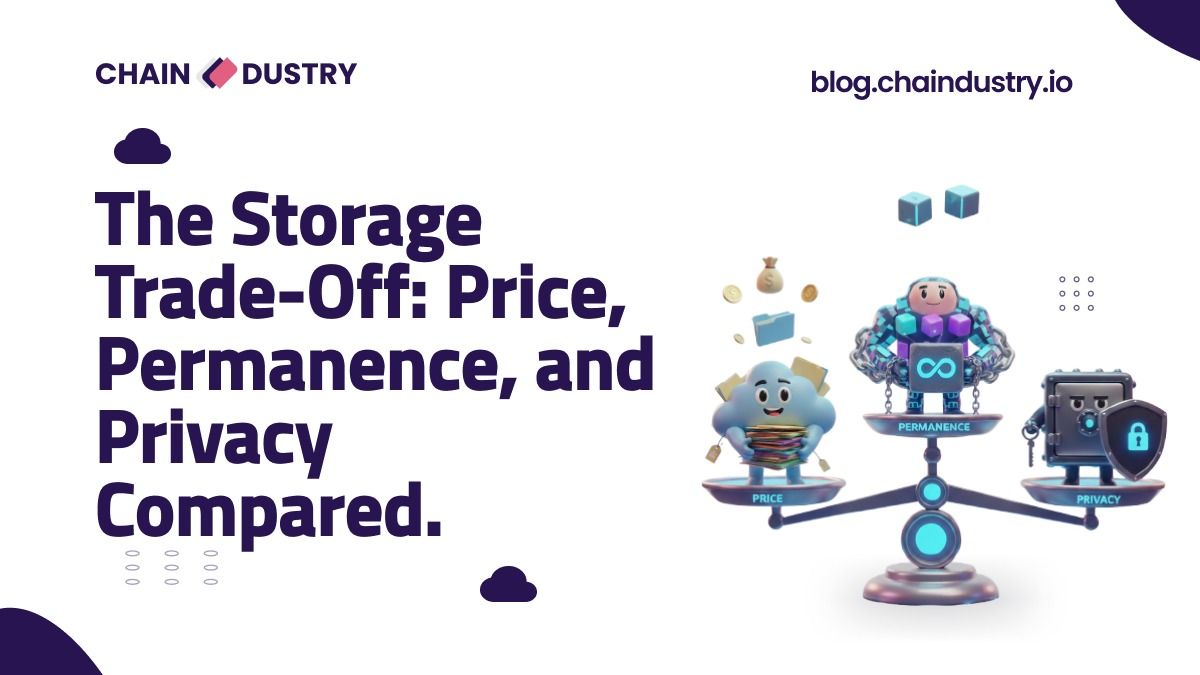
The Storage Trade-Off: Price, Permanence, and Privacy Compared
Filecoin focuses on ongoing storage. You pay providers to store your data for a set period. If they fail to do so, they lose collateral. This model works well for large datasets, apps, and content that changes frequently.
Arweave focuses on permanence. You pay once and your data is designed to stay available long term. This appeals to creators publishing articles, research, NFTs, and historical records that should not disappear. The trade off is flexibility.
Filecoin is cheaper over short periods but requires maintenance. Arweave costs more upfront but removes the need to think about renewals.
Privacy depends on how you encrypt your files before uploading. The network stores data, but you control who can read it.
Who Is Actually Using This Today
This is not theoretical. NFT platforms use decentralized storage to ensure metadata does not vanish. Journalists use it to publish uncensorable articles. Developers use it to host frontends that cannot be taken down.
Some teams even back up critical documents alongside traditional cloud storage as a safety net. It is not replacing Google Drive for family photos yet. But for important work, it is becoming the second copy people trust more.
Should You Switch Completely?
For most people, the answer is no. Not yet. Decentralized storage still requires more setup, basic crypto knowledge, and patience. Interfaces are improving, but convenience still favors centralized tools. The smarter move is hybrid usage. Keep everyday files where they are. Use decentralized storage for things that matter long term, cannot be censored, or must remain verifiable. That is where the real value shows up.
Conclusion
This is not a loud revolution. It is a quiet migration. Decentralized storage is not trying to beat Google Drive at simplicity. It is solving a different problem entirely. Ownership, permanence, and independence.
As the internet matures, people will care less about where files are easy to upload and more about where files are guaranteed to survive. That is the battle playing out right now, and blockchain based storage is slowly gaining ground.